Beyond the Prompt
Why your vibe coding with Claude is worthless without a human system
Folagbade Abitogun
3/6/20265 min read
If you are feeling a bit of whiplash right now, you are not alone, Gem. In just a few short years, we moved from being amazed by generated emails to watching autonomous agents build whole web applications.
Digital marketing in 2026 is fundamentally different. We are no longer simply using AI to generate text; we use it to decide what to do. Tools like Claude, GPT, Gemini, Perplexity, Cursor, and Google Antigravity have made the hardest part no longer execution. The difficult part of it all is now imagination, judgment, and, crucially, operational execution- coming up with smart decisions and doing the job right.
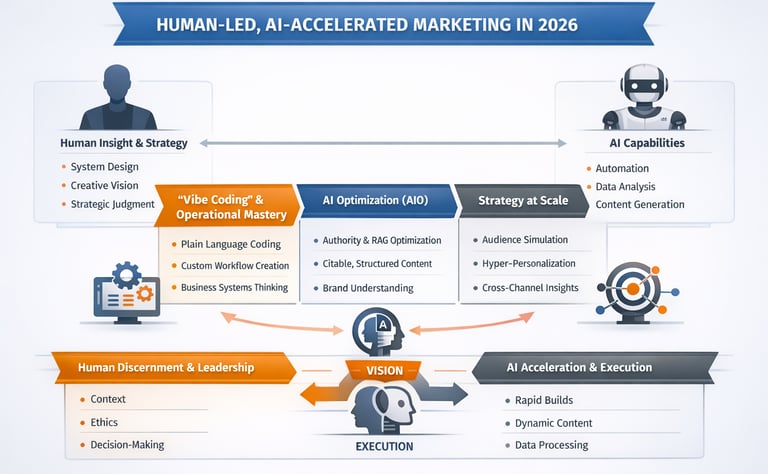
However, with all these amazing AI capabilities, one truth remains: the future is not owned by machines alone. It still belongs to humans who can think clearly, design wisely, exercise discernment, and build systems that actually serve people. AI may speed up work and output, but it cannot replace responsibility, taste, context, conviction, or care. That is why this moment is not just about artificial intelligence. It is about amplified human agency- about people doing more.
The playbook is being re-written and here’s how:
The “Vibe Coding” Culture & The Operational Advantage
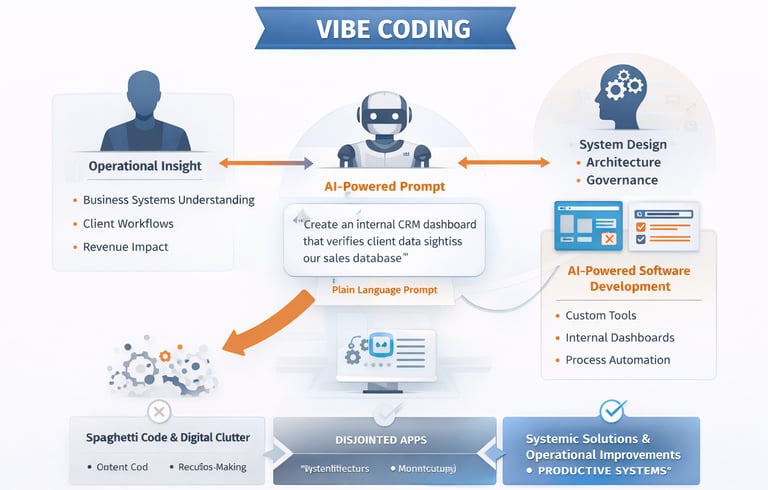
If you are a digital marketer, you’d know the struggle of going through the friction between a creative idea and the engineering backlog. Today, one of the biggest shifts is transitioning from marketer to maker through everyone’s friend and everyone’s enemy- vibe coding. In plain terms, it is everyone’s friend because it means you can use plain English in tools like Claude, ChatGPT, Codex, Cursor or Google Antigravity to generate software. On the other side of it, it is everyone’s enemy because of the potential carelessness of the humans behind those plain English prompts.
Now, this has sparked a massive culture war. Traditional developers are understandably frustrated, warning that non-technical people shipping products will inevitably create insecure spaghetti code, fragile systems, and mountains of technical debt. See where the enemy is born now?
But that pushback, while valid in part, misses the deeper paradigm shift.
Contrary to how the users see it, vibe coding is not a magic wand that turns everyone into a great developer. It is a force multiplier for the ones who are deeply operational. It rewards the people who truly understand the real machinery of work. Anyone can prompt an AI to build a shiny, disjointed app. But without a rigorous understanding of business systems, client workflows, governance, edge cases, or how a custom tool actually drives revenue, vibe coding simply produces more digital clutter, more interfaces, more noise, more things that look impressive but actually solve nothing.
The real unlock happens when systems thinkers take the steering wheel of Claude, Codex, Antigravity, or Cursor.
So, for human-AI hybrid teams that deeply understand the mechanics of scaling operations, people who know exactly why a custom workflow, a verification tool, an internal CRM dashboard, or an approval engine needs to exist in order to remove a bottleneck, then the barrier to entry has been radically lowered. Vibe coding shifts the work from writing syntax to designing systems, and that distinction matters. Because syntax can now be generated, our human minds still need to understand systems, imagine architecture, make trade-offs, and account for real-world messiness.
Ultimately, the winners will not be those who can prompt the fastest. Rather, it will be the smart ones, the operationally rigorous architects who know exactly what to build, why it matters, where it fits, and how it creates value.
The Shift from SEO to AIO (Enter Perplexity)
Traditional Search Engine Optimization is rapidly giving way to or maybe embracing AI Optimization (AIO). Users are increasingly bypassing traditional search results in favor of answer engines like Perplexity, which provide synthesized responses backed by citations.
SO, as a marketer, the playbook has flipped for you, and here is how:
Authority Over Keywords: Keyword volume is taking a back seat to semantic authority, original data, clear expertise, and distinctive perspective.
Optimizing for the RAG: You are now optimizing for Retrieval-Augmented Generation. Your content must be structured with such clarity that an AI can easily parse it, understand it, trust it, and confidently cite it as a definitive source. It is no longer solely about ranking in Google.
Brand as an Entity: The focus is no longer just ranking pages. It is ensuring that these models understand your brand’s relationship to specific concepts, categories, and problems across the web.
While AI is taking the bolder steps here, the human role becomes more important, not less. AI can retrieve, summarize, and synthesize but can’t originate lived authority. It cannot manufacture a real point of view. It cannot replace the kind of insight that comes from deep work, earned pattern recognition, sharp positioning, and genuine experience in the trenches.
Now, if you still chunk out bland, derivative and forgettable content, everyone ignores it, even the machines. What wins is content with clarity, structure, originality, and conviction. In other words: content built by humans who actually know what they are talking about, using AI as an amplifier rather than a substitute.
Strategy at Scale (Enter Claude, GPT, & Gemini)
It’s 2026! We are long gone from just prompting an AI to “write five tweets about my company.” Today’s frontier models are increasingly functioning as strategic partners.
Audience Simulation: Marketers are creating custom sub-agents to simulate target personas, running messaging past a synthetic panel of buyers to surface objections before spending real dollars on ads.
Hyper-Personalization: AI models are dynamically generating personalized landing pages and email journeys in real time based on behavioral signals.
Unifying the Stack: By processing massive context windows, marketers are feeding models their campaign data, customer signals, market research, and internal knowledge at once to identify cross-channel patterns that human analysts might miss on a first pass.
Again, this is powerful but it does not remove the need for human strategy. Rather, it raises the standard for it. This is because the value is no longer in producing more words or more assets but in asking better questions, framing the right problems, choosing the right constraints, interpreting outputs wisely, and knowing which recommendations should be trusted, tested, refined, or even rejected.
While AI can expand the strategic surface area, humans still provide the strategic center of gravity.
A model can generate options. A human still decides what is wise for them.
A model can identify patterns. A human still decides what is meaningful in their own context.
A model can accelerate execution. A human still decides what is worth executing in the first place.
Humans have context that is driven by their lived experiences and their environments. That is why the most effective teams in this era will not be purely AI-driven. They will be human-led and AI-accelerated.
The Bottom Line
Fundamentally, this technology removes many of the traditional barriers to entry. The tools no longer dictate what we can create. Our operational systems, strategic maturity, and human judgment do.
That is the real shift.
We are now in a space where everyone wants to execute. And when execution becomes an every hour meal, discernment, taste, systems thinking, operational rigor, and human leadership all become premium.
The marketers who will thrive are not the ones who hand everything over to AI. They are the ones who lean into this newfound agency while staying deeply human. They will treat AI as a collaborative engine to architect, test, and scale better experiences, while retaining responsibility for the vision, the structure, the ethics, the nuance, and the outcome.
Because even now, especially now, the future belongs to humans who know how to think, build, and lead.